
Questions about air quality
What should you do when air quality is poor?
Many studies have identified strong links between increased levels of air pollution and more hospital admissions for heart and respiratory ailments, as well as higher death rates from these ailments during smog events. People who are sensitive to air pollution should keep informed about air quality in their area and plan outdoor physical activities to avoid periods of poor air quality. They may also want to consult with their physician for advice that is specific to their needs. Current air quality information is available by calling 902-424-2775 or by visiting Environment Canada's Air Quality website. Further information is available from Environment Canada and Health Canada.
There are a number of actions you can take to reduce your contribution to poor air quality. Some of these actions are listed in the next section.
What can you do to make air quality better in Nova Scotia?
The main sources of air pollution from within Nova Scotia come from the burning of fossil fuels for electricity generation and transportation. Residential wood burning is also a major source of air pollution in Nova Scotia.
You can do a lot to make air quality better. Although individually we each produce less pollution than a major industry, there are a lot more of us. We also drive industrial and commercial production through our demand for goods and services. Collectively, our actions can make a great impact. It all adds up. Here are some tips for what we can do to improve air quality. Almost all of these suggestions have the added advantage of reducing energy costs as well.
- Drive less - All Nova Scotians can help reduce air pollution by reducing the amount we drive, choosing more fuel efficient automobiles, maintaining our vehicles with regular engine tune-ups and avoiding unnecessary trips. The Personal Vehicles Initiative provides helpful tips on buying, driving and maintaining vehicles to reduce fuel consumption and pollution. Using public transit, cycling, walking, or carpooling will help reduce both air pollution and traffic congestion. This chart shows how our normal driving patterns can affect air pollution in Halifax. The peaks are caused by periods of heavy traffic.
Nitrogen Oxide in downtown Halifax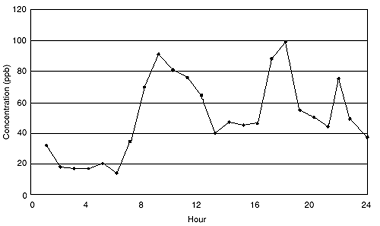
- Turn your vehicle off - We can reduce air pollution by turning off our engines when our vehicles are parked. Ten seconds of idling uses more fuel than restarting the vehicle's engine! The Idle-Free Zone provides more information about what you can do to stop unnecessary engine idling.
Nova Scotia Environment has a fact sheet (PDF:46k) with some myths and quick tips about vehicle idling.
 - Cut down on the use of small engine motors - Reducing or eliminating our use of small gas powered engines such as gas lawn mowers, leaf blowers, chain saws, lawn and garden tractors, ATVs, snowmobiles, outboard motors and personal watercraft will also help to reduce air pollution. Consumers should inquire about emissions when they are comparing brands.
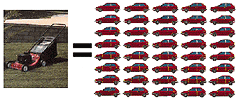
Did you know that a gas-powered lawnmower or similar small two-stroke engine pollutes the same as 40 late model cars? (Source: South Coast Air Quality Management District) - Use energy efficiently - We can also look at how we can save energy in our homes by reducing electricity use and heating and cooling needs. Actions such as turning off lights, turning down thermostats, using low flow shower heads and cold water for laundry, updating household appliances and products with low-energy models, adding insulation and weather stripping to homes and using air conditioners wisely during the summer months can make a positive difference. Further information which will help you reduce energy use and save money as well as reduce air pollution can be found at the Nova Scotia Department of Energy and Natural Resources Canada's Office of Energy Efficiency
- Burn wood efficiently - Individuals who burn wood can make a difference by ensuring they are using dry wood and are burning it at high temperatures using proper, well-maintained equipment that has been EPA/CSA certified for emission controls. Wood burning can significantly increase air pollutants both indoors and outdoors. Backyard wood burning units can also contribute to poor air quality. Further information about wood heating can be found at the Nova Scotia Department of Energy.
- Reduce chemical emissions - To help reduce chemical emissions, reduce or eliminate your outdoor use of volatile organic compound-releasing products such as oil-based paints, lawn pesticides, car cleaning solvents and waxes. Fill your gas tank during cooler hours to avoid evaporation of volatile organic compounds into the air.
Learn More
Other ideas for reducing air pollution are available from Environment Canada and Pollution Probe through the following websites:
- Commuter Challenge
- Choose what you use
- Clean Air
- What you can do
- Pollution Probe - The Smog Primer
- The One Tonne Challenge
What is Nova Scotia Environment doing about air quality?
This map (PDF:1.3mb) shows where air quality is monitored in Nova Scotia. We maintain air monitoring stations in Aylesford, Dartmouth, Halifax, Pictou, Port Hawkesbury and Sydney. We also provide technical support for a station on Sable Island. Environment Canada maintains stations in Dayton, Kejimkujik National Park and Kentville. The stations are located in commercial, industrial and residential areas.
We also maintain an acid rain monitoring station at Sherbrooke in Guysborough County. Environment Canada maintains acid rain monitoring stations at Jackson (also known as Cobequid) in Cumberland County, and at Kejimkujik National Park in Annapolis County. Acid rain monitoring is done as part of the Canadian Air and Precipitation Monitoring Network (CAPMoN).
We are also expanding our air quality program with additional staff and equipment. This allows us to provide data for smog forecasts and other information to help individuals take appropriate actions. It also provides us with information needed to make sound policy decisions to reduce air pollution.
Nova Scotia Environment is involved with a number of provincial, national and international initiatives aimed at reducing the emissions which cause air pollution both in Nova Scotia and in North America.
Provincially, our chief concern is with the air that Nova Scotians breathe. The Nova Scotia Air Quality Regulations (N.S. Reg. 28/2005) provide outdoor air quality standards. As well, major industries in the province have air emission terms and conditions in their operating approvals.
The Nova Scotia Energy Strategy identifies the province's commitments to reduce air pollutant emissions from the generation and consumption of energy, consistent with national standards. These commitments include:
2001-2005
- Reduce sulphur dioxide (SO2) emissions by 25% from 2001 levels by 2005.
- Reduce mercury (Hg) emissions by 30% below 1995 levels by 2005.
- Negotiate agreements with the federal government and other provinces to establish a framework for co-operative and co-ordinated action.
- Work with existing facilities to model and monitor (where appropriate) the effects of their emissions to ensure that emission-reduction initiatives are having the desired results.
- Continue to require all utility and industrial boilers to install low-NOx burner technology during upgrades and natural capital stock turnover.
2006 and Beyond
- Further reduce SO2 in the longer term to achieve a cumulative reduction goal of 50% by 2010 (by those sources existing in 2001).
- Reduce NOx emissions by 20% below 2000 levels by 2009.
- Comply with Canada-wide Standards for Particulate Matter and Ozone by 2010.
- Continue to require all utility and industrial boilers to install low-NOx burner technology during upgrades and natural capital stock turnover.
The Nova Scotia Energy Strategy provides emission reduction targets until 2010, as shown in this table:
| Pollutant | Target to be met by | Emissions Target | Reduction |
|---|---|---|---|
| Sulphur Dioxide (SO2) | 2005 | 141,750 tonnes | 25% reduction from 2001 levels |
| Mercury (Hg) from electric power generation | 2005 | 168 kg | 30% reduction from 1995 levels |
| Nitrogen oxides (NOx) | 2009 | 72,000 tonnes | 20% reduction from 2000 levels |
| Sulphur Dioxide (SO2) | 2010 | 94,500 tonnes (by sources existing in 2001) | 50% cumulative reduction from 2001 levels (by sources existing in 2001) |
Industrial Air Emission Fees
In April 2004, the Nova Scotia Government revised the annual Industrial Air Emission Fees (N.S. Reg 69/2016). Based on the polluter-pays principle, the government charges annual pollution fees to facilities in Nova Scotia that produce emissions to air above a threshold. The fees cover the costs of provincial programs for managing air quality issues in Nova Scotia.
International Initiatives
Recognizing the fact that air pollution does not stop at national or provincial borders, we are also working with other jurisdictions on agreements and standards to address air quality. These long-term initiatives require both technological investments and societal changes with respect to our dependence on fossil fuels.