

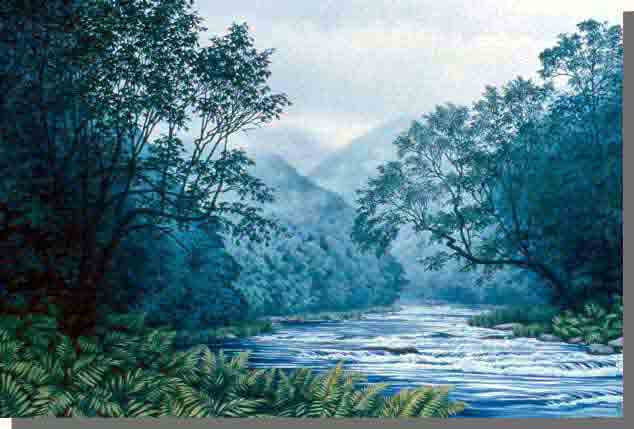
 Trout Brook Wilderness Area protects old deciduous forest in the Trout Brook canyon complex and a unique yellow birch – balsam fir forest on the Keppoch plateau. The wilderness area rises above the southern end of Lake Ainslie, Nova Scotia's largest natural freshwater lake.
The mixed yellow birch – balsam fir plateau forest is transitional between the hardwood-dominated lowlands, and the balsam fir forests of the higher elevation Cape Breton Boreal Plateau natural landscape to the north. Yellow birch forms the canopy, with an understory of balsam fir. The birch range from young to about 170 years of age, while the fir is even-aged and younger. Stands of old black spruce and fir occur in adjacent, poorly drained flats.
Parts of the Trout Brook canyon complex shelter old-growth sugar maple-yellow birch forest. Mature conifers become more common at the upper elevations. These old forest conditions provide habitat for American marten, an elusive and endangered species that finds sanctuary in older forests.
Trout Brook Wilderness Area was established in 1998. It was expanded by almost 200 hectares in 2015, and another 38 hectares in 2023.
The western part of the wilderness area extends to Highway 395, where Trout Brook flows into Lake Ainslie. This lower section of Trout Brook, near the Highway 395 bridge, is part of a Special Trout Management Area. Details on angling regulations that apply to this part of the wilderness area can be found in the “Nova Scotia Anglers Handbook”, published annually by the provincial Department of Fisheries and Aquaculture.
The southeastern, upland part of the wilderness area borders Humes River Wilderness Area at a major forest access road near Lewis Mountain.
Together, Trout Brook Wilderness Area, Humes River Wilderness Area and Trout Brook Provincial Park form a protected natural corridor that extends from Bras d’Or Lake to Lake Ainslie across the Keppoch Plateau. This supports wide ranging wildlife species in the region, such as marten and endangered Canada lynx, and provides unique opportunities for wilderness recreation and nature tourism. There are currently no managed trails here.