| This consolidation is unofficial and is for reference only. For the official version of the regulations, consult the original documents on file with the Office of the Registrar of Regulations, or refer to the Royal Gazette Part II. |
| Regulations are amended frequently. Please check the list of Regulations by Act to see if there are any recent amendments to these regulations filed with our office that are not yet included in this consolidation. |
| Although every effort has been made to ensure the accuracy of this electronic version, the Office of the Registrar of Regulations assumes no responsibility for any discrepancies that may have resulted from reformatting. |
| This electronic version is copyright © , Province of Nova Scotia, all rights reserved. It is for your personal use and may not be copied for the purposes of resale in this or any other form. |
Commercial Vehicle Drivers’ Hours of Service Regulations
made under Section 303 of the
Motor Vehicle Act
R.S.N.S. 1989, c. 293
O.I.C. 2022-327 (effective January 1, 2023), N.S. Reg. 330/2022
Table of Contents
Please note: this table of contents is provided for convenience of reference and does not form part of the regulations.
Click here to go to the text of the regulations.
Director designated by Minister
Responsibility of carrier, shipper, consignee and driver to restrict driving
On-duty Time and Off-duty Time
Maximum daily driving time and maximum daily on-duty time
Time spent travelling as passenger is off-duty time
Deferral of daily off-duty time
Mandatory off-duty time when driver travelling by ferry
Single driver splitting daily off-duty time
Team of drivers splitting daily off-duty time
Driver must follow cycle 1 or cycle 2
Mandatory off-duty time in 14-day period
Maximum on-duty time for cycle 1 driver
Maximum on-duty time for cycle 2 driver
Off-duty time before cycle reset
Off-duty time before cycle switched
Special permits for research or pilot projects
Special permits for commercial vehicles other than oil well service vehicles
Special permits for oil well service vehicles
Information specified in special permit
Obligations of special permit holders
Amending, suspending or cancelling special permits
Emergencies and Adverse Driving Conditions
Extending driving time in emergencies
Extending driving time in adverse driving conditions
Reason for extending time recorded in record of duty status
Requirement to fill out record of duty status
Content of record of duty status
Using electronic recording devices
Possession of records of duty status and supporting documents by drivers
Distributing and keeping records of duty status
Tampering and falsifying record of duty status
Inter-provincial carriers and ELDs
Certification of record of duty status
Verification of records of duty status
Authority to enter premises for inspection
Obstructing inspector or making false statements
Records of duty status and supporting documents produced by driver
Records of duty status and supporting documents produced by carrier
Schedule 1: Criteria for Sleeper Berths
Schedule 2: Duty Status Information for a Record of Duty Status
Schedule 3: Inspector’s Receipt
1 These regulations may be cited as the Commercial Vehicle Drivers’ Hours of Service Regulations.
2 (1) In these regulations,
“Act” means the Motor Vehicle Act;
“adverse driving conditions” means snow, sleet, fog or other adverse weather or road conditions that were not known to a driver or a carrier dispatching a driver immediately before the driver began driving or could not reasonably have been known to them;
“carrier” means a person who owns, leases or is otherwise responsible for the operation of a commercial vehicle;
“co-driver” means a person who is present in a commercial vehicle because they have been or are about to be its driver;
“commercial vehicle” means
(i) a truck, truck-tractor or trailer, or any combination of them, that exceeds a registered gross vehicle weight of 4500 kg, or
(ii) a bus that is designed and constructed to have a designated seating capacity of more than 10 persons, including the driver, and is used for transporting passengers for compensation;
“cycle” means 1 of the following periods during which a driver’s on-duty time is accumulated:
(i) cycle 1, under which on-duty time is accumulated over 7 consecutive days,
(ii) cycle 2, under which on-duty time is accumulated over 14 consecutive days;
“day”, in respect of a driver, means a 24-hour period that begins at the hour designated by the carrier for the duration of the driver’s cycle;
“director” means the person designated by the Minister under Section 4;
“driver” means any of the following and, for the purposes of Section 46, includes a co-driver:
(i) a person who operates a commercial vehicle,
(ii) in relation to a carrier, a person who is employed or otherwise engaged by the carrier to operate a commercial vehicle, including a self-employed driver;
“duty status” means any of the following periods of time:
(i) off-duty time, other than time spent in a sleeper berth,
(ii) off-duty time spent in a sleeper berth,
(iii) driving time,
(iv) on-duty time, other than driving time;
“elapsed time” means the 16-hour period referenced in subsection 7(2);
“electronic logging device” or “ELD” means a device or technology that automatically records a driver’s driving time and facilitates the recording of the driver’s record of duty status, and that is certified by an accredited certification body under Section 79.1 of the Federal regulations;
“electronic recording device” means an electric, electronic or telematic device that is installed in a commercial vehicle and is capable of accurately recording, in accordance with Section 33, each period of duty status, in whole or in part;
“emergency vehicle” means any of the following vehicles:
(i) a fire-fighting vehicle, ambulance, police vehicle or other vehicle that is used for emergency purposes,
(ii) a vehicle engaged in snow removal or ice control operated by or on behalf of a government agency,
(iii) a vehicle operated by or on behalf of a public utility when performing emergency repair services;
“Federal Act” means the Motor Vehicle Transport Act (Canada);
“Federal regulations” means the Commercial Vehicle Drivers Hours of Service Regulations made under the Federal Act;
“home terminal” means a carrier’s place of business where a driver ordinarily reports for work and, for the purpose of recording information related to the drivers’ record of duty status, includes a temporary work site designated by the carrier;
“inspector” means
(i) a motor vehicle inspector appointed under Section 6 of the Act, or
(ii) a peace officer within the meaning of Section 2 of the Criminal Code (Canada);
“inter-provincial carrier” means a motor carrier that is engaged in an undertaking that connects a province with any other province or extends beyond the limits of a province;
“Minister” means the Minister of Public Works;
“off-duty time” means any time other than on-duty time;
“oil well service vehicle” means a commercial vehicle that meets all of the following criteria:
(i) it is specially constructed, altered or equipped to accommodate a specific service requirement associated with the oil or natural gas industry,
(ii) it is used exclusively in the oil or natural gas industry for transporting equipment or materials to and from oil or natural gas facilities or for servicing and repairing oil or natural gas facilities;
“on-duty time” means the time beginning from when a driver starts work or is required by the carrier to be available to work, other than when the driver is waiting to be assigned to work, and ending when the driver stops work or is relieved of responsibility by the carrier, and includes driving time and time spent by the driver doing any of the following activities:
(i) inspecting, servicing, repairing, conditioning, fuelling or starting a commercial vehicle,
(ii) travelling in a commercial vehicle as a co-driver, when the time is not spent in the sleeper berth of the vehicle,
(iii) participating in the loading or unloading of a commercial vehicle,
(iv) inspecting or checking the load of a commercial vehicle,
(v) waiting for a commercial vehicle to be serviced, loaded, unloaded or dispatched,
(vi) waiting for a commercial vehicle or its load to be inspected and the driver’s requirements are assessed, and, if relevant, the time spent taking the required remedial actions,
(vii) waiting at an en-route point because of an accident or other unplanned occurrence or situation,
(viii) performing any work for any carrier,
(ix) performing yard moves of a commercial vehicle within a terminal, depot or port and that is not on a public road; and
(x) resting in or occupying a commercial vehicle for any other purpose, except during any of the following times:
(A) time counted as off-duty time in accordance with Section 8,
(B) time spent in the sleeper birth of the vehicle,
(C) time spent in the vehicle when it is stationary to satisfy the off-duty requirements of Section 9,
(D) time spent in the vehicle when it is stationary that is in addition to the off-duty requirements of Section 9;
“out-of-service declaration” means a declaration issued by the director or an inspector under Section 43 to a driver for contravention of these regulations;
“personal use” of a commercial vehicle means the use of the vehicle by a driver other than in the course of business as a carrier;
“principal place of business” means the place or places designated by the carrier where records of duty status and supporting documents are stored;
“record of duty status” means a record in which a driver records the information required under Sections 31 to 33 or 37, as the case may be, for each day;
“recreational vehicle” means a vehicle that is designed as mobile accommodation and used as transportation for personal and recreational purposes without compensation, and includes a cabin trailer, collapsible cabin trailer, tent trailer and camping trailer;
“sleeper berth” means a sleeper berth as defined in Schedule 1;
“special permit” means an authorization to operate a commercial vehicle with exceptions and variances to the provisions of these regulations that is granted to a carrier under Section 20, 21 or 22;
“supporting document” means any one of the following documents or information received or prepared by a driver in the course of their duties or received or prepared by the carrier:
(i) any electronic mobile communication record reflecting communications between a driver and a carrier transmitted through a driver call-in or fleet management system,
(ii) any payroll record, settlement sheet or equivalent document that indicates payments to the driver,
(iii) any government-issued document indicating the location of the commercial vehicle,
(iv) any reports, receipts, records or other documentation relating to the load of the commercial vehicle, including any bill of lading, itinerary, schedule or equivalent document that indicates the origin and destination of each trip,
(v) any reports, receipts, records or other documentation relating to the servicing, repairing, conditioning, fuelling, inspection or rental of the commercial vehicle,
(vi) any reports, dispatch or trip records, receipts, or other documentation indicating the date, time, or location of the commercial vehicle during a trip, including arrival and departure times;
“Technical Standard” means the Technical Standard for Electronic Logging Devices, April 11, 2019, published by the Canadian Council of Motor Transport Administrators, as amended from time to time.
(2) For the purposes of these regulations, every reference to “HOS Regulations” in the Technical Standard must be read as a reference to these regulations.
3 These regulations apply to all commercial vehicles other than the following vehicles:
(a) a 2-axle or 3-axle commercial vehicle while it is being used for any of the following when the driver or the carrier is the producer or user of the products:
(i) a trip to pick up feed grain, fertilizer or the primary products of a farm, forest, sea or lake,
(ii) a trip to transport feed grain, fertilizer or the primary products of a farm, forest, sea or lake,
(iii) a return trip after transporting an item in subclause (ii), if the vehicle is empty or is transporting a supply item used in the production of a primary product of a farm, forest, sea or lake;
(b) an emergency vehicle;
(c) a vehicle engaged in providing relief during a public welfare emergency as defined in the Emergencies Act (Canada) or during an emergency as defined in the Emergency Management Act;
(d) a bus that is part of the public transit service that is provided in any of the following:
(i) a municipality,
(ii) 2 or more bordering municipalities,
(iii) within 25 km of the boundary of a municipality or 2 or more bordering municipalities that the transit service serves;
(e) a commercial vehicle when driven for personal use, if all of the following conditions are met:
(i) the vehicle does not have a load,
(ii) no trailers are hitched to the vehicle,
(iii) the vehicle does not travel farther than 75 km in a day,
(iv) the driver records the odometer reading in the record of duty status at the beginning and end of the personal use,
(v) the driver is not the subject of an out-of-service declaration;
(f) a recreational vehicle.
Director designated by Minister
4 The Minister may designate a person to exercise the duties and functions of the director under these regulations.
Responsibility of carrier, shipper, consignee and driver to restrict driving
5 A carrier, shipper, consignee or other person must not request, require or allow a driver to drive and a driver must not drive in any of the following circumstances:
(a) driving would jeopardize or be likely to jeopardize the safety or health of the public, the driver or the employees of the carrier;
(b) the driver is the subject of an out-of-service declaration;
(c) by driving, the driver would not be in compliance with these regulations.
On-duty Time and Off-duty Time
Maximum daily driving time and maximum daily on-duty time
6 Except as otherwise provided in these regulations, a carrier must not request, require or allow a driver to drive and a driver must not drive again in a day after the driver has accumulated
(a) 13 hours of driving time in the day; or
(b) 14 hours of on-duty time in the day.
7 (1) Unless a driver has taken at least 8 consecutive hours of off-duty time before driving again, a carrier must not request, require or allow the driver to drive and the driver must not drive again after the driver has accumulated
(a) 13 hours of driving time; or
(b) 14 hours of on-duty time.
(2) A carrier must not request, require or allow a driver to drive and a driver must not drive again if 16 hours has elapsed between the end of the driver’s most recent period of 8 or more consecutive hours of off-duty time and the beginning of the next period of 8 or more consecutive hours of off-duty time.
Time spent travelling as passenger is off-duty time
8 Time spent by a driver as a passenger by any mode of transportation is counted as off-duty time if all of the following conditions are met:
(a) at the request of the carrier who employs or otherwise engages the driver, the time is spent travelling to the destination where the driver will begin driving;
(b) the driver has taken 8 consecutive hours of off-duty time before the driver begins to drive.
9 (1) Except as otherwise provided in these regulations, a carrier must ensure that a driver takes and the driver must take at least 10 hours of off-duty time in a day and the 10 hours must include
(a) 8 consecutive hours of off-duty time; and
(b) at least 2 hours of off-duty time that is not part of the 8 consecutive hours of off-duty time required by clause (a).
(2) Off-duty time other than the 8 consecutive hours required by clause (1)(b) may be distributed throughout the day in blocks of at least 30 minutes each.
Deferral of daily off-duty time
10 (1) Except as prohibited in subsection (2), a driver may defer a maximum of 2 hours of daily off-duty time to the following day if all of the following criteria are met:
(a) the off-duty time deferred is not part of the daily 8 consecutive hours of off-duty time required by clause 9(1)(a);
(b) the total off-duty time taken in the 2 days is at least 20 hours;
(c) the deferred off-duty time is taken consecutively with the daily 8 consecutive hours of off-duty time that the driver takes in the 2nd day;
(d) the total driving time accumulated by the driver in the 2 days does not exceed 26 hours;
(e) the driver adds a declaration in their record of duty status that
(i) states that the driver is deferring off-duty time under this Section, and
(ii) clearly indicates whether the driver is driving under day 1 or day 2 of the days affected by the deferral.
(2) The following drivers must not defer their daily off-duty time under this Section:
(a) a driver who is splitting off-duty time in accordance with Section 12 or 13;
(b) a driver operating under an oil well service vehicle special permit granted under Section 22.
Mandatory off-duty time when driver travelling by ferry
11 A driver taking a commercial vehicle on a ferry crossing that takes more than 5 hours is not required to take 8 consecutive hours of off-duty time as required by Sections 7 and 9 if all of the following criteria are met:
(a) all of the following time spent by the driver totals at least 8 hours:
(i) time spent in a sleeper berth at the terminal while waiting to board the ferry,
(ii) time spent in rest accommodations on the ferry,
(iii) time spent in a sleeper berth at a rest stop that is 25 km or less from the point where the vehicle disembarks from the ferry;
(b) the times listed in clause (a) are recorded in the record of duty status as off-duty time spent in a sleeper berth;
(c) the driver retains the receipt for the crossing and rest accommodation fees as a supporting document, and the receipt coincides with the record of duty status entries.
Single driver splitting daily off-duty time
12 (1) A driver of a commercial vehicle fitted with a sleeper berth may meet the 8 consecutive hours of mandatory off-duty time required by Section 7 and the minimum 10 hours of daily off-duty time required by Section 9 by accumulating off-duty time in 2 periods if all of the following criteria are met:
(a) neither period of off-duty time is shorter than 2 hours;
(b) the total of the 2 periods of off-duty time is at least 10 hours;
(c) the off-duty time is spent resting in the sleeper berth;
(d) none of the daily off-duty time is deferred to the next day;
(e) the total of the driving time in the periods immediately before and after each of the periods of off-duty time is not longer than 13 hours;
(f) the total of the on-duty time in the periods immediately before and after each of the periods of off-duty time does not include any driving time after the 14th hour;
(g) the elapsed time in the periods immediately before and after each of the periods of off-duty time does not include any driving time after the 16th hour after the driver comes on duty.
(2) The 16th hour referred to in clause (1)(g) is calculated as follows:
(a) by excluding any period spent in the sleeper berth that
(i) is 2 hours or longer in duration, and
(ii) totals at least 10 hours when added to a subsequent period in the sleeper berth; and
(b) by including all of the following:
(i) all on-duty time,
(ii) all off-duty time not spent in the sleeper berth,
(iii) all periods of less than 2 hours spent in the sleeper berth,
(iv) any time spent in the sleeper berth that does not qualify as counting towards meeting the requirements of this Section.
(3) After a driver takes their split daily off-duty time in accordance with subsection (1), a carrier must not request, require or allow the driver to drive again and the driver must not drive again in accordance with the requirements of Sections 7 and 9 without first taking at least 8 consecutive hours of off-duty time.
Team of drivers splitting daily off-duty time
13 (1) A team of drivers of a commercial vehicle fitted with a sleeper berth may meet the 8 consecutive hours of mandatory off-duty time required by Section 7 and the minimum 10 hours of daily off-duty time required by Section 9 by accumulating off-duty time in 2 periods if all of the following criteria are met:
(a) neither period of off-duty time is shorter than 4 hours;
(b) the total of the 2 periods of off-duty time is at least 8 hours;
(c) the off-duty time is spent resting in the sleeper berth;
(d) none of the daily off-duty time is deferred to the next day;
(e) the total of the driving time in the periods immediately before and after each of the periods of off-duty time is not longer than 13 hours;
(f) the total of the on-duty time in the periods immediately before and after each of the periods of off-duty time does not include any driving time after the 14th hour;
(g) the elapsed time in the periods immediately before and after each of the periods of off-duty time does not include any driving time after the 16th hour after the driver comes on duty.
(2) The 16th hour referred to in clause (1)(g) is calculated as follows:
(a) by excluding any period spent in the sleeper berth that
(i) is 4 hours or longer in duration, and
(ii) totals at least 8 hours when added to a subsequent period in the sleeper berth; and
(b) by including all of the following:
(i) all on-duty time,
(ii) all off-duty time not spent in the sleeper berth,
(iii) all periods of less than 4 hours spent in the sleeper berth,
(iv) any time spent in the sleeper berth that does not qualify as counting towards meeting the requirements of this Section.
(3) After a team of drivers takes their split daily off-duty time in accordance with subsection (1), a carrier must not request, require or allow the team drivers to drive again and the team drivers must not drive again in accordance with the requirements of Sections 7 and 9 without each driver first taking at least 8 consecutive hours of off-duty time.
Driver must follow cycle 1 or cycle 2
14 A carrier must require that a driver follow either cycle 1 or cycle 2 and a driver must follow either cycle 1 or cycle 2.
Mandatory off-duty time in 14-day period
15 Subject to the longer minimums required by Sections 18 and 19 for when a cycle is reset or switched, a carrier must not request, require or allow a driver to drive and a driver must not drive again unless the driver has taken at least 24 consecutive hours of off-duty time in the previous 14 days.
Maximum on-duty time for cycle 1 driver
16 A carrier must not request, require or allow a driver who is following cycle 1 to drive and a driver who is following cycle 1 must not drive again after the driver has accumulated 70 hours of on-duty time during any of the following:
(a) any 7 consecutive days;
(b) the cycle that was ended or switched from, for a driver who has reset their cycle in accordance with Section 18 or switched their cycle in accordance with Section 19.
Maximum on-duty time for cycle 2 driver
17 A carrier must not request, require or allow a driver who is following cycle 2 to drive and a driver who is following cycle 2 must not drive again in their current cycle after the driver has accumulated
(a) 120 hours of on-duty time during any of the following:
(i) any 14 consecutive days, or
(ii) the cycle that was ended or switched from, for a driver who has reset their cycle in accordance with Section 18 or switched their cycle in accordance with Section 19; or
(b) 70 hours of on-duty time, unless the driver takes at least 24 consecutive hours of off-duty time.
Off-duty time before cycle reset
18 (1) A driver may end their current cycle and begin a new cycle that is the same as their current cycle if the driver first takes the following off-duty time:
(a) for cycle 1, at least 36 consecutive hours;
(b) for cycle 2, at least 72 consecutive hours.
(2) After a driver takes the off-duty time required by subsection (1), the driver begins a new cycle, the accumulated hours are set back to zero and the driver’s hours begin to accumulate again.
Off-duty time before cycle switched
19 (1) A carrier must not request, require or allow a driver to switch and a driver must not switch from one cycle to the other without first taking the following off-duty time before driving again:
(a) to switch from cycle 1 to cycle 2, at least 36 consecutive hours;
(b) to switch from cycle 2 to cycle 1, at least 72 consecutive hours.
(2) After a driver takes the off-duty time required by subsection (1), the driver begins the other cycle, the accumulated hours are set back to zero and the driver’s hours begin to accumulate again.
Special permits for research or pilot projects
20 (1) The director may issue a special permit to a carrier for the purpose of a research or pilot project if the safety and health of the public, the driver and the employees of the carrier are not jeopardized or are unlikely to be jeopardized.
(2) An applicant for a special permit under this Section must include a detailed work plan with their application that includes at least all of the following information for the proposed research or pilot project:
(a) the nature of the project;
(b) the objectives of the project;
(c) the competence of the applicant to participate in the project;
(d) the criteria and method for measuring results;
(e) the safety implications and the approach to addressing any possible risks identified;
(f) the duration of the project;
(g) the manner of and timing for reporting results.
(3) Sections 6 to 19 and 27 to 42 do not apply to a carrier and its drivers when operating under a special permit issued under this Section, but Sections 23 to 26 apply with any modifications that the circumstances require.
Special permits for commercial vehicles other than oil well service vehicles
21 (1) The director may issue a special permit to a carrier for a commercial vehicle other than an oil well service vehicle if all of the following conditions are met:
(a) off-duty time required under these regulations needs to be reduced or driving time and on-duty time required under these regulations needs to be increased for any of the following purposes:
(i) to allow a driver following a regular itinerary to reach their home terminal or destination,
(ii) to allow the delivery of perishable goods,
(iii) to accommodate a significant temporary increase in the transportation of passengers or goods by the carrier;
(b) the safety and health of the public, the driver and the employees of the carrier are not jeopardized or are unlikely to be jeopardized.
(2) The only deviations from the requirements of these regulations that may be authorized in a special permit issued under this Section are the following:
(a) reducing the 2 additional hours of daily off-duty time required by clause 9(1)(b); and
(b) increasing the maximum daily driving time and on-duty time required by Section 6 by up to a total of 2 hours.
Special permits for oil well service vehicles
22 (1) The director may issue a special permit to a carrier for an oil well service vehicle if all of the following conditions are met:
(a) the driver has successfully completed training directly related to safety requirements associated with operating within the field services sector of the oil or natural gas industry;
(b) the safety and health of the public, the driver and the employees of the carrier are not jeopardized or are unlikely to be jeopardized.
(2) Sections 14 to 19 do not apply to a carrier and its drivers when operating under an oil well service vehicle special permit, but the special permit must require that the driver take, and the driver must take, all of the following off-duty time instead:
(a) a minimum of 3 periods of off-duty time during any 24 consecutive days that are
(i) at least 24 consecutive hours each, and
(ii) taken consecutively or separated by on-duty time;
(b) a minimum of 72 consecutive hours of off-duty time after the driver finishes driving under the special permit and before the driver begins driving again.
(3) Waiting time and standby time at an oil or natural gas well site or ancillary facility is not included as on-duty time for a driver operating under an oil well service vehicle special permit if all of the following conditions are met:
(a) the driver performs no work during the time;
(b) the time is fully and accurately recorded in the record of duty status as off-duty time and denoted as waiting or standby time;
(c) the time is not included in the 8 consecutive hours of mandatory off-duty time required by Section 7 or the daily 8 consecutive hours of off-duty time required by Section 9.
(4) When a driver who has been driving under an oil well service vehicle special permit begins to drive again under Sections 14 to 19, they begin to accumulate hours in the cycle.
(5) None of the daily off-duty time may be deferred to the next day.
23 (1) A carrier may apply to the director for a special permit by providing all of the following information and documents to the director:
(a) the name of the carrier;
(b) all of the following for each driver who will operate a commercial vehicle under the special permit:
(i) name,
(ii) driver’s license number and province where the license was issued;
(c) a list of the commercial vehicles which will be operated by the carrier under the special permit;
(d) a list of all accidents involving the carrier or any of its drivers that occurred during the previous 6 months, if the laws of the province, state or country in which the accidents occurred require the accidents to be reported to police;
(e) the duration requested by the carrier for the special permit;
(f) the schedule requested by the carrier for operating under the special permit;
(g) the reasons for the application and evidence supporting the reasons;
(h) a copy of each special permit issued to the carrier under these regulations in the previous 5 years;
(i) a signed declaration that discloses all of the following:
(i) any application made under these regulations by the carrier for a special permit,
(ii) any application for a special permit made by the carrier to any provincial or territorial director in the previous 6 months under any province’s regulations respecting commercial drivers hours of service;
(j) if trucks will be operated under the special permit, a detailed description of the load for which the permit will apply;
(k) if buses will be operated under the special permit, a detailed description of the route for which the permit will apply;
(l) for a special permit issued under Section 20, the work plan required by subsection 20(2).
(2) The director may, at any time after the application has been made, require an applicant to provide additional information in order for the director to evaluate whether the granting of a permit would be likely to jeopardize the safety or health of the public, the driver or the employees of the carrier.
(3) A carrier applying for a special permit must make all of the following information available to the director on request for each driver who will operate a commercial vehicle under the special permit:
(a) the records of duty status for the previous 6 months;
(b) supporting documents or records of on-duty times for the previous 6 months.
Information specified in special permit
24 The director must specify all of the following in a special permit:
(a) the reasons for issuing the permit;
(b) the duration of the permit, which must not exceed 1 year;
(c) any terms or conditions required for the protection of the safety or health of the public, the driver or the employees of the carrier.
Obligations of special permit holders
25 (1) A carrier to whom a special permit is issued must do all of the following:
(a) require that a copy of the special permit is placed in each commercial vehicle operating under the permit;
(b) provide the director with a list of the commercial vehicles that will be operating under the permit and keep the director informed of any changes to the list;
(c) make all of the following information immediately available to the director on request for each driver who operates a commercial vehicle under the permit:
(i) record of duty status,
(ii) supporting documents and any related relevant records;
(d) notify the director without delay of any accidents involving any of the commercial vehicles operating under the permit if the laws of the province, state or country in which the accidents occurred require that the accident be reported to the police.
(2) A carrier must ensure that a driver driving under a special permit issued to the carrier drives and a driver driving under a special permit must drive in accordance with the terms and conditions of the special permit.
Amending, suspending or cancelling special permits
26 The director may amend, suspend or cancel a carrier’s special permit in any of the following circumstances by giving the carrier written notice:
(a) the carrier or any of its drivers contravenes these regulations or any condition of the special permit;
(b) the director determines that the safety and health of the public, the driver or the employees of the carrier are jeopardized or are likely to be jeopardized.
Emergencies and Adverse Driving Conditions
Extending driving time in emergencies
27 (1) In this Section and in Section 29, “emergency,” in relation to a commercial vehicle, means an unexpected event or situation that constitutes a danger to any of the following:
(a) the occupants of the commercial vehicle;
(b) the security of the commercial vehicle and its load;
(c) road users.
(2) Despite any other provision of these regulations, a driver who requires more driving time in an emergency to avoid the dangers listed in subsection (1) and reach a safe destination may drive longer than the maximum driving times and on-duty times required by these regulations and take less than the off-duty times required by these regulations to reach the safe destination.
Extending driving time in adverse driving conditions
28 A driver who encounters adverse driving conditions while driving a commercial vehicle may drive longer than the maximum 13 hours of driving time and the maximum 14 hours of daily on-duty time required by Sections 6 and 7 and reduce the 2 hours of daily off-duty time required by Section 9 by the amount of time needed to complete the trip if all of the following criteria are met:
(a) the driving, on-duty and elapsed times in the cycle are not extended more than 2 hours;
(b) the driver takes the 8 consecutive hours of mandatory off-duty time required by Section 7;
(c) the trip could have been completed under normal driving conditions without extending the driving, on-duty and elapsed times and reducing off-duty time.
Reason for extending time recorded in record of duty status
29 A driver who exceeds their driving time, on-duty time or elapsed times, or reduces their off-duty time because of an emergency or adverse driving conditions must record the reason for doing so in the record of duty status.
30 Time recorded by a driver in a record of duty status must be recorded using the local time at the driver’s home terminal.
Requirement to fill out record of duty status
31 (1) Except as provided in subsection (2), a carrier must require a driver to fill out and each driver must fill out a record of duty status each day that accounts for all of the driver’s on-duty time and off-duty time for that day.
(2) The requirement to fill out a record of duty status in subsection (1) does not apply if all of the following criteria are met:
(a) the driver is not driving under a special permit;
(b) the driver operates or is instructed by the carrier to operate a commercial vehicle within a radius of 160 km of the home terminal;
(c) the driver returns to the home terminal each day to begin a minimum of 8 consecutive hours of off-duty time;
(d) either 1 of the following conditions is met:
(i) the carrier maintains accurate and legible records showing, for each day, the cycle the driver followed and on-duty times and keeps those records and the supporting documents relating to those records for a minimum period of 6 months after the day on which each record was recorded,
(ii) for at least 6 months after the date the records were created, the carrier maintains accurate and legible records for each driver for each day showing the hour that each on-duty segment starts and ends and the total on-duty time, and all of the following conditions are met:
(A) the driver’s elapsed time does not exceed 16 hours,
(B) the driver’s total on-duty time does not exceed 14 hours,
(C) the driver maintains accurate and legible records for each day showing the hour that each on-duty segment starts and ends and the total on-duty time, and the records for the previous 7 days are kept in the vehicle for inspection.
Content of record of duty status
32 (1) A carrier must require that a driver enters legibly and the driver must legibly enter all of the following information in a record of duty status for the day at the beginning of the driver’s first on-duty time for the day or, if not known, at the first on-duty time of the day as it known:
(a) the date;
(b) their start time, if other than midnight;
(c) the driver’s name;
(d) the names of any co-drivers;
(e) the cycle the driver is following, other than for a driver who is driving under an oil well service vehicle special permit:
(f) the license plates or unit numbers of each commercial vehicle operated by the driver;
(g) for each commercial vehicle operated by the driver, the odometer reading when the driver begins driving;
(h) the names and the addresses of
(i) the home terminal, and
(ii) the principal place of business of each carrier who employs or otherwise engages the driver during the day;
(i) if the carrier or driver was not required to keep a record of duty status immediately before the beginning of the day, the number of hours of off-duty time and on-duty time that were accumulated by the driver each day during the previous 14 days;
(j) for a driver who has deferred off-duty time under Section 10, a declaration in the record of duty status in accordance with clause 10(1)(e).
(2) A carrier must require that a driver records and a driver must record all of the following information in a record of duty status as the information becomes known:
(a) the time the driver spends in each duty status during the day, in accordance with Schedule 2;
(b) if the driver’s driving time is interrupted by a number of periods of other on-duty time of less than 1 hour each, the periods of driving time may be combined and the periods of other on-duty time may be combined;
(c) the name of the municipality, or the location on a highway or in a community, and the name of the province or state where each of the driver’s duty status changes occurred during the day.
(3) A carrier must require that a driver records and a driver must record all of the following in a record of duty status at the end of each day:
(a) the total time the driver spends in each duty status during the day;
(b) the total distance driven by the driver during the day, excluding any distance driven for the driver’s personal use;
(c) the odometer reading of each commercial vehicle operated by the driver at the end of the day;
(d) the name of the municipality or legal subdivision and the name of the province or state where a change in duty status occurs or, if the change in duty status occurs at a location other than a municipality or legal subdivision, one of the following:
(i) the highway number and the nearest kilometre marker as well as the name of the nearest municipality or legal subdivision,
(ii) the highway number and the nearest service plaza as well as the name of the nearest municipality or legal subdivision,
(iii) the numbers of the highways that meet at the nearest intersection as well as the name of the nearest municipality or legal subdivision.
(4) A carrier must require that a driver signs and a driver must sign the record of duty status completed by the driver, attesting to the accuracy of the information recorded in it.
Using electronic recording devices
33 A driver may use an electronic recording device for recording their duty status if all of the following criteria are met:
(a) the information contained in the electronic recording device is the same as the information that would have been provided if it had been submitted as a record of duty status in paper format;
(b) the driver can immediately provide the information for the previous 14 days to the director or an inspector, when requested, by producing it in any of the following ways or combination of the following ways:
(i) on a digital display screen of the electronic recording device,
(ii) in handwritten form,
(iii) on a print-out or other intelligible output;
(c) the device is capable of displaying all of the following information:
(i) the driving time and other on-duty time for each day the device is used,
(ii) the total on-duty time accumulated and the total on-duty time remaining in the cycle the driver is following,
(iii) the changes in duty status in chronological order and the time that each change occurred for each day the device is used;
(d) the driver can prepare a handwritten record of duty status from the information stored in the device for each day the device is used if requested by an inspector;
(e) the device automatically records the time and date any time it is disconnected and any time it is reconnected and stores the record;
(f) the device records the time the driver spent in each duty status;
(g) any hard copy of the record of duty status that is generated from the information stored in the device is signed on each page by the driver, attesting to its accuracy;
(h) the carrier provides blank record of duty status forms in the commercial vehicle for the driver’s use.
Possession of records of duty status and supporting documents by drivers
34 A driver who is required to fill out a record of duty status must not drive and a carrier must not request, require or allow the driver to drive unless the driver has all of the following in their possession:
(a) a copy of the records of duty status for the previous 14 days;
(b) for a driver driving under an oil well service vehicle special permit, a copy of the logs for each of the 3 periods of 24-hour off-duty time required by clause 22(2)(a) during any 24 consecutive days;
(c) the record of duty status for the current day, completed up to the time that the driver’s duty status last changed;
(d) any supporting documents and any related relevant records that the driver received during the current trip.
Distributing and keeping records of duty status
35 (1) A driver must, within 20 days after completing a record of duty status, forward the record of duty status and supporting documents relating to that record to the home terminal and the carrier must ensure that the driver does so.
(2) A driver who is employed or otherwise engaged by more than one carrier in any day must forward, within 20 days after completing a paper record of duty status, and the carriers must ensure that the driver forwards, the original record of duty status to the home terminal of the last carrier for which the driver worked and a copy to the home terminal of each other carrier for which the driver worked, as well as the supporting documents relating to that record to the home terminal of the carrier for which the driver worked during the periods referred to in those supporting documents.
(3) A carrier must do all of the following with the records of duty status and supporting documents of the drivers it employs or otherwise engages:
(a) deposit them at its principal place of business no later than 30 days after the date they are received;
(b) keep them for at least 6 months, in chronological order for each driver.
Tampering and falsifying record of duty status
36 (1) A carrier must not request, require or allow a driver to keep and a driver must not keep more than 1 record of duty status for each day.
(2) A carrier must not request, require or allow any person to do any of the following and a person must not do any of the following:
(a) enter inaccurate information in a record of duty status, whether it is handwritten or produced using an electronic recording device;
(b) falsify, mutilate or deface a record of duty status or supporting documents.
(3) A carrier must not request, require or allow any person to, and a person must not, disable, deactivate, disengage, jam or otherwise block or degrade a signal transmission or reception, or re-engineer, reprogram or otherwise tamper with an ELD so that the device does not accurately record and retain the data that is required to be recorded and retained.
Inter-provincial carriers and ELDs
37 (1) Despite Sections 31 and 33, an inter-provincial carrier must ensure that each commercial vehicle that it operates is equipped with an ELD that meets the requirements of the Technical Standard, and must ensure that it is mounted in a fixed position during the operation of the commercial vehicle and is visible to the driver when the driver is in the normal driving position, with the exception of commercial vehicles that are
(a) operated by a carrier under a permit obtained under Section 61 of the Federal regulations;
(b) operated by a carrier to which an exemption has been issued under the Act;
(c) the subject of a rental agreement of no longer than 30 days that is not an extended or renewed rental of the same vehicle; or
(d) manufactured before model year 2000.
(2) The carrier must require the driver to record, and the driver must record for each day, in accordance with these regulations and the Technical Standard, all the information associated with their record of duty status as their duty status changes.
(3) Subsections (1) and (2) do not apply if
(a) the driver drives or is instructed by the carrier to drive a commercial vehicle within a radius of 160 km of the home terminal;
(b) the driver returns to the home terminal each day to begin a minimum of 8 consecutive hours of off-duty time; and
(c) the carrier maintains accurate and legible records showing, for each day, the cycle the driver followed and on-duty times and keeps those records and the supporting documents related to those records for a minimum period of 6 months after the day on which each record was recorded.
(4) If a carrier authorizes a driver to operate a commercial vehicle for yard moves within a terminal, depot or port and that is not on a public road, the carrier must ensure that the driver’s ELD has been configured so that the driver can indicate those moves.
(5) A driver must manually input or verify all of the following information on the ELD:
(a) the date and the start time, if different from midnight, and their driver identification number;
(b) the cycle that the driver is following;
(c) the commercial vehicle license plates as well as the unit number or trailer number, if applicable;
(d) the names and the addresses of the home terminal and the principal place of business of the carrier by which the driver was employed or otherwise engaged during that day;
(e) the commercial vehicle’s location description, if it is not automatically drawn from the ELD’s geo-location database;
(f) if the driver was not required to keep a record of duty status immediately before the beginning of the day, the number of hours of off-duty time and on-duty time that were accumulated by the driver each day during the 14 days immediately before the beginning of the day;
(g) any deferral of off-duty time under Section 10;
(h) if the driver was working for more than one carrier during the current day or the previous 14 days
(i) for each day during the 14 days immediately before the current day, the total number of hours for each duty status that were accumulated by the driver, and the beginning and end time of each 16-hour period referred to in subsection 7(2), and
(ii) the start and end times of each duty status in the current day, before the use of the ELD;
(i) any annotation necessary to complete the record of duty status.
(6) A carrier must not request, require or allow a driver to use, and a driver must not use, more than one ELD at the same time for the same period.
(7) The carrier must ensure that each commercial vehicle that it operates carries an ELD information package containing a current version of the following documents:
(a) a user’s manual;
(b) an instruction sheet for the driver describing the data transfer mechanisms supported by the ELD and the steps required to generate and transfer the data with respect to the driver’s hours of service to an inspector;
(c) an instruction sheet for the driver describing the measures to take in the event that the ELD malfunctions; and
(d) a sufficient number of records of duty status to allow the driver to record the information required under Section 32 for at least 15 days.
(8) The carrier must ensure that the driver records the information related to their record of duty status and the driver is required to record that information in a complete and accurate manner.
38 (1) A carrier must ensure that any ELD that is installed or used in a commercial vehicle that it operates is in good working order and is calibrated and maintained in accordance with the manufacturer’s or seller’s specifications.
(2) If a driver of a commercial vehicle becomes aware of the fact that the ELD is displaying a malfunction code set out in Table 4 of Schedule 2 of the Technical Standard, the driver must notify the carrier that is operating the commercial vehicle as soon as the vehicle is parked.
(3) The driver must record, in the record of duty status on the day on which they noticed the malfunction, the following information:
(a) the malfunction as set out in Table 4 of Schedule 2 of the Technical Standard;
(b) the date and time when the malfunction was noticed; and
(c) the time when notification of the malfunction was transmitted to the carrier.
(4) The driver must record the code referred to in clause (3)(a) in each record of duty status following the day on which the code was noticed, until the ELD is repaired or replaced.
(5) A carrier must, within 14 days after the day on which it was notified of an ELD malfunction code by the driver or otherwise became aware of it, or at the latest, upon return of the driver to the home terminal from a planned trip if that return exceeds the 14-day period, repair or replace the ELD.
(6) The carrier must maintain a register of ELD malfunction codes for ELDs installed or used in commercial vehicles that it operates for which a malfunction was noticed, and that register must contain all of the following information:
(a) the name of the driver who noticed the malfunction code;
(b) the name of each driver that used the commercial vehicle following the discovery of the malfunction code until the ELD was repaired or replaced;
(c) the make, model and serial number of the ELD;
(d) the licence plate of the commercial vehicle in which the ELD is installed or used, or the Vehicle Identification Number;
(e) the date when the malfunction code was noticed and the location of the commercial vehicle on that date, as well as the date when the carrier was notified or otherwise became aware of the code;
(f) the date the ELD was replaced or repaired;
(g) a concise description of the actions taken by the carrier to repair or replace the ELD.
(7) The carrier must retain the information set out in subsection (6) for each ELD for which a malfunction was noticed for a period of 6 months from the day on which the ELD is replaced or repaired.
39 A carrier must create and maintain a system of accounts for ELDs that is in compliance with the Technical Standard and that
(a) allows each driver to record their record of duty status in a distinct and personal account; and
(b) provides for a distinct account for the driving time of an unidentified driver.
Certification of record of duty status
40 A driver must, immediately after recording the last entry for a day, certify the accuracy of their record of duty status.
Verification of records of duty status
41 (1) A carrier must verify the accuracy of the certified records of duty status that are forwarded by the driver according to the supporting documents provided and must require from the driver those changes necessary to ensure the accuracy of the records.
(2) The driver must either accept or reject the changes required by the carrier, make the necessary changes and recertify the accuracy of their record of duty status and forward the amended records of duty status to the carrier.
42 (1) A carrier must monitor each of its drivers to ensure the driver complies with these regulations.
(2) A carrier that determines that a driver who is employed or otherwise engaged by the carrier has not complied with these regulations must take immediate remedial action, issue a notice of non-compliance to the driver and record all of the following:
(a) the dates the non-compliance occurred;
(b) the date the notice of non-compliance was issued;
(c) the remedial action taken.
43 (1) The director or an inspector may issue an out-of-service declaration for a driver in any of the following circumstances:
(a) the driver contravenes clause 5(a);
(b) the driver fails to comply with any of the driving time or off-duty time requirements
(i) in Sections 6 to 19, or
(ii) for a special permit;
(c) the driver is unable or refuses to produce the record of duty status, supporting documents and any other related relevant records as required by Section 41;
(d) there is evidence that shows that the driver has done any of the following in contravention of Section 36:
(i) completed more than 1 record of duty status,
(ii) entered inaccurate information in a record of duty status,
(iii) falsified information in a record of duty status;
(e) in contravention of Section 36, the driver has mutilated or defaced a record of duty status or a supporting document in such a way that the director or inspector cannot determine whether the driver has complied with the driving time and off-duty time requirements:
(i) in Sections 6 to 19, or
(ii) for a special permit issued under Section 20, 21 or 22;
(f) if the driver uses an ELD, the driver uses an ELD that has a disabled, deactivated, disengaged, jammed or otherwise blocked or degraded signal transmission or reception, or uses an ELD that has been re-engineered, reprogrammed or otherwise tampered with so that it does not accurately record and retain the data that is required to be recorded and retained, in such a way that the director or inspector is unable to determine whether the driver has complied with the driving time and off-duty time requirements of Sections 11 to 19 or of a term or condition of a permit.
(2) An out-of-service declaration issued under subsection (1) must be issued in writing to both the driver and the carrier who employs or otherwise engages the driver and must include all of the following:
(a) the reasons the driver has been issued the declaration;
(b) the length of time the declaration applies, in accordance with subsection (3).
(3) An out-of-service declaration issued for a driver prohibits the driver from operating a commercial vehicle, including operating a commercial vehicle for personal use, and applies for the following applicable length of time:
(a) for 10 consecutive hours, if the driver contravenes clause 5(a) or 5(b);
(b) for 10 consecutive hours, if the driver contravenes Section 6;
(c) for the number of hours needed to correct the failure, if the driver fails to comply with the off-duty time requirements of any of Sections 6 to 19;
(d) subject to any further hours required to comply with subsection (4), for 72 consecutive hours, if the driver contravenes Section 36.
(4) An out-of-service declaration issued for a driver who contravenes Section 36 continues to apply beyond the 72 hours specified in clause (3)(d) until the driver makes any necessary changes to correct the record of duty status and provides the record of duty status to the director or inspector, and the director or inspector is able to determine whether the driver has complied with these regulations.
Authority to enter premises for inspection
44 (1) During business hours, an inspector may enter a home terminal or principal place of business, other than living quarters, to inspect records of duty status, supporting documents and any related relevant records.
(2) At any time, an inspector may stop and enter a commercial vehicle, except for its sleeper berth, to inspect records of duty status and supporting documents.
(3) At any time, an inspector may stop a commercial vehicle and enter its sleeper berth to verify that the sleeper berth meets the criteria in Schedule 1.
Obstructing inspector or making false statements
45 A person must not obstruct or hinder, or knowingly make any false or misleading statements either orally or in writing to an inspector who is engaged in carrying out their duties and functions under these regulations.
Records of duty status and supporting documents produced by driver
46 (1) At the request of an inspector, a driver must immediately produce all of the following for inspection for the current trip and the previous 14 days:
(a) records of duty status;
(b) supporting documents and any related relevant records;
(c) any special permit that the driver has driven under.
(2) At the request of an inspector, a driver must retrieve the information stored by any electronic recording device installed in a commercial vehicle for each day the device was used.
(3) If the records requested by the inspector are in electronic format, the driver must produce either the display or a printout of the records and, if requested by the inspector to transmit the records of duty status, must transmit them by the transfer method identified by the inspector that is provided for in the Technical Standard and is supported by the ELD.
(4) At the request of an inspector, a driver must immediately give the inspector a copy of all of the following for the previous 14 days, or the originals of all of the following if it is not possible in the circumstances to make copies:
(a) records of duty status;
(b) supporting documents and any related relevant records;
(c) any special permit that the driver has driven under;
(d) records of driving time of an unidentified driver;
(e) the documents referred to in subsection 77(7) of the Federal regulations;
(f) the register of ELD malfunction set out in subsection 78(6) of the Federal regulations;
(g) the information recorded under subsection 37(2) or under subsection 87(2) of the Federal regulations.
(5) An inspector must provide a receipt in the form set out in Schedule 3 for any information given to the inspector under subsection (3).
(6) The carrier must transmit to the inspector the electronic records of duty status in the format, and using one of the transfer methods, prescribed in the Technical Standard.
Records of duty status and supporting documents produced by carrier
47 (1) At the request of an inspector, a carrier must immediately make all of the following available for inspection during business hours at a place specified by the inspector:
(a) records of duty status;
(b) supporting documents and any related relevant records;
(c) records of driving time of an unidentified driver;
(d) the documents referred to in subsection 37(2);
(e) the register of ELD malfunction;
(f) any special permit that a driver employed or otherwise engaged by the carrier has been driving under during the period the information is requested for.
(2) An inspector must do all of the following with any records of duty status, supporting documents, related relevant records and special permits received by the inspector under subsection (1):
(a) immediately return any unexpired special permits and provide the carrier with a receipt in the form set out in Schedule 3 for any expired special permits and other information received by the inspector under subsection (1);
(b) return all expired special permits and other information received by the inspector under subsection (1) no later than 14 days after the date the inspector received them.
48 Any person who violates clause 34(c) is guilty of an offence and liable on summary conviction to the penalties provided for a category B offence in the Summary Proceedings Act.
49 Any person who violates any of the following provisions of these regulations is guilty of an offence and liable on summary conviction to the penalties provided for a category C offence in the Summary Proceedings Act:
(a) Section 32;
(b) subsection 35(1) or (2).
50 Any person who violates any of the following provisions of these regulations is guilty of an offence and liable on summary conviction to the penalties provided for a category D offence in the Summary Proceedings Act:
(a) clause 5(c);
(b) clause 6(a) or (b);
(c) clause 7(1)(a) or (b) or subsection 7(2);
(d) subsection 9(1);
(e) subsection 12(3);
(f) subsection 13(3);
(g) Section 14;
(h) Section 15;
(i) Section 16;
(j) clause 17(a) or (b);
(k) clause 19(1)(a) or (b);
(l) clause 22(2)(a) or (b);
(m) Section 29;
(n) clause 38(3)(a), (b) or (c) or subsection [38](4).
51 Any person who violates any of the following provisions of these regulations is guilty of an offence and liable on summary conviction to the penalties provided for a category E offence in the Summary Proceedings Act:
(a) clause 25(1)(a), (b), (c) or (d);
(b) subsection 25(2);
(c) subsection 31(1);
(d) clause 34(a), (b) or (d);
(e) clause 35(3)(a) or (b);
(f) clause 37(5)(a), (b), (c), (d), (e), (f), (g), (h) or (i);
(g) subsection 41(2);
(h) clause 46(1)(a), (b) or (c), subsection 46(2), or clause 46(4)(a), (b), (c) or (d).
52 Any person who violates any of the following provisions of these regulations is guilty of an offence and liable on summary conviction to the penalties provided for a category F offence in the Summary Proceedings Act:
(a) clause 5(a) or (b);
(b) subsection 37(2);
(c) subsection 37(6);
(d) clause 37(7)(a), (b), (c) or (d);
(e) subsection 37(8);
(f) subsection 38(2);
(g) Section 40;
(h) subsection 41(2);
(i) subsection 42(1) or (2);
(j) clause 47(1)(a), (b) or (f).
53 Any person who violates any of the following provisions is guilty of an offence and liable on summary conviction to the penalties provided for a category G offence in the Summary Proceedings Act:
(a) subsection 36(1), clause 36(2)(a) or (b) or subsection 36(3);
(b) subsection 37(4);
(c)subsection 41(1);
(d) Section 45.
54 Any person who violates any of the following provisions is guilty of an offence and liable on summary conviction to the penalties provided for a category H offence in the Summary Proceedings Act:
(a) subsection 37(2) or (6);
(b) subsection 38(1);
(c) subsection 38(5);
(d) clause 38(6)(a), (b), (c), (d), (e), (f) or (g);
(e) subsection 38(7);
(f) Section 39 or clause 39(b);
(g) subsection 41(1) or (2);
(h) clause 46(4)(e), (f) or (g);
(i) clause 47(1)(c), (d) or (e).
Schedule 1: Criteria for Sleeper Berths
An area of a commercial vehicle is a sleeper berth if it meets all of the following criteria:
(a) it is designed to be used as sleeping accommodation;
(b) it is located in the cab of the commercial vehicle or immediately adjacent to the cab and is securely fixed to it;
(c) it is not located in or on a semi-trailer or a full trailer;
(d) if it is located in the cargo space, it is securely compartmentalized from the remainder of the cargo space;
(e) for a bus,
(i) it is located in the passenger compartment,
(ii) it is at least 1.9 m in length, 60 cm in width and 60 cm in height,
(iii) it is separated from the passenger area by a solid physical barrier that is equipped with a door that can be locked,
(iv) it provides privacy for the occupant, and
(v) it is equipped with a means to significantly limit the amount of light entering the area;
(f) for a commercial vehicle other than a bus, it is rectangular in shape with the following minimum dimensions:
(i) 1.9 m in length, measured on the centre line of the longitudinal axis,
(ii) 60 cm in width, measured on the centre line of the transverse axis, and
(iii) 60 cm in height, measured from the sleeping mattress to the highest point of the area;
(g) it is constructed so that there are no impediments to ready entrance to or exit from the berth;
(h) there is a direct and readily accessible means of passing from it into the driver’s seat or compartment;
(i) it is protected against leaks and overheating from the vehicle’s exhaust system;
(j) it is equipped to provide adequate heating, cooling and ventilation;
(k) it is reasonably sealed against dust and rain;
(l) it is equipped with a mattress that is at least 10 cm thick and adequate sheets and blankets so that the occupant can get restful sleep;
(m) it is equipped with a means of preventing the occupant from being ejected from the berth when the commercial vehicle is decelerating that is designed, installed and maintained to withstand a total force of 2700 kg applied toward the front of the vehicle and parallel to the longitudinal axis of the vehicle.
Schedule 2: Duty Status Information for a Record of Duty Status
Duty Status
Name______________________________________ Date _________________
Cycle 1 (7 days) OR Cycle 2 (14 days)
(Hour that day begins—use local time at home terminal)
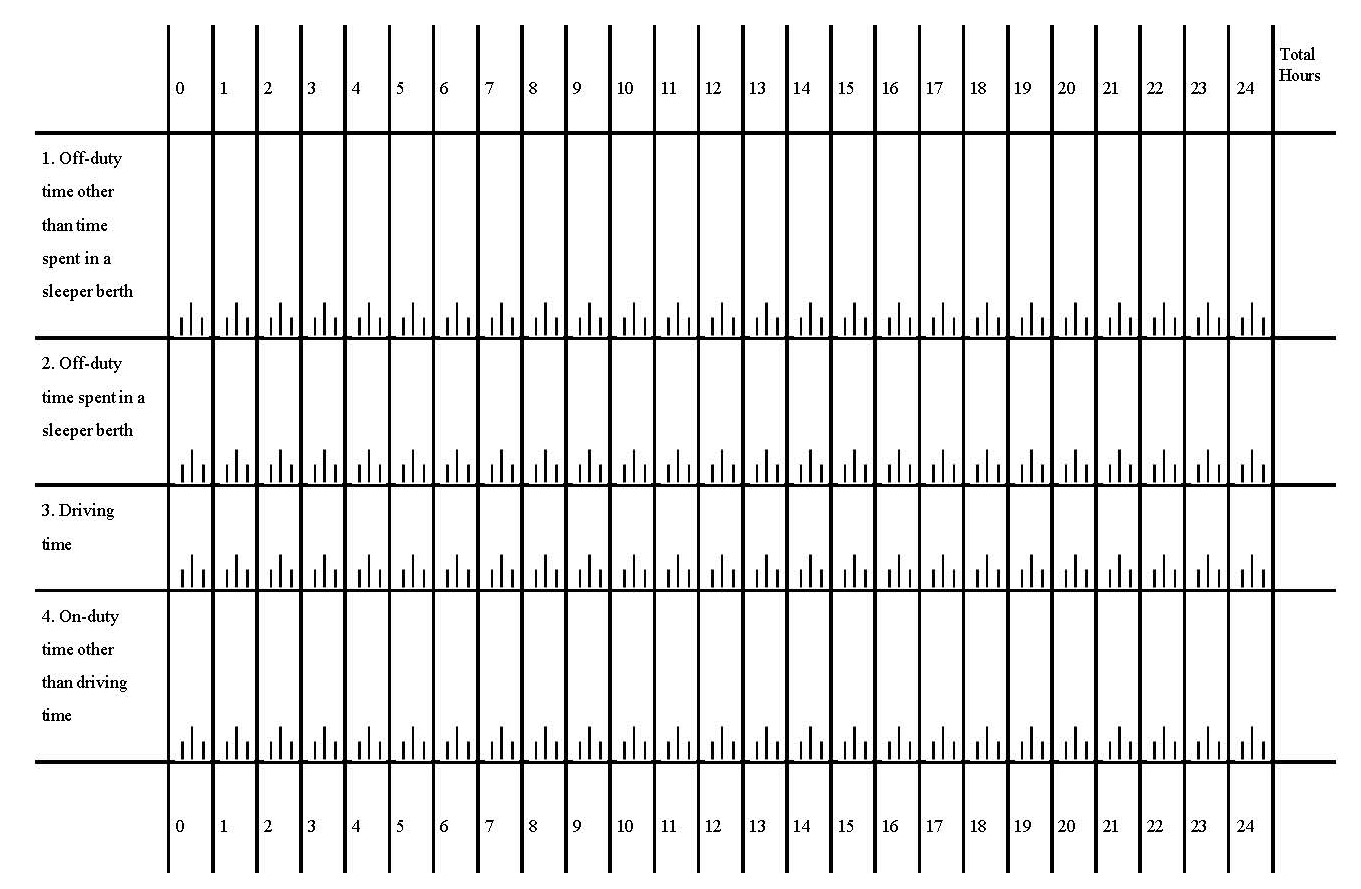
Remarks ___________________________________________________
Total distance driven _________________________________________
Signature ___________________________________________________
Instructions for Recording Duty Status
Filling out grid
Fill out the grid as follows:
(1) for each duty status,
• mark the beginning time and the end time
• draw a continuous line between the time markers
(2) in the last column on the right of the grid, enter the total number of hours of each period of duty status (total of all periods must be 24 hours)
Change in duty status remarks
For each change in duty status, record the following in the Remarks section:
• the name of the municipality where the change occurred
OR
• the location on a highway or in a community and the name of the province or state where the change occurred
Schedule 3: Inspector’s Receipt
(subsection 46(5) and subsection 47(2) of the
Commercial Vehicle Drivers’ Hours of Service Regulations)
I, _______________________, an inspector under Section 6 of the Motor Vehicle Act, acknowledge that the following records of duty status, supporting documents and other records were provided by
(name of person)
at (number, street, municipality, location, province of carrier)
on (day, month, year)
namely: (description of records of duty status, supporting documents and records received)
(municipality, location) on (day, month, year)
__________________________________________________
Inspector’s signature
Legislative History
Reference Tables
Commercial Vehicle Drivers’ Hours of Service Regulations |
N.S. Reg. 330/2022 |
Motor Vehicle Act |
|
Note: The information in these tables does not form part of the regulations and is compiled by the Office of the Registrar of Regulations for reference only. |
|
Source Law
The current consolidation of the Commercial Vehicle Drivers’ Hours of Service Regulations made under the Motor Vehicle Act includes all of the following regulations:
N.S. |
In force |
How in force |
Royal Gazette |
330/2022
|
Jan 1, 2023 |
date specified |
Dec 30, 2022 |
|
|
|
|
|
|
|
|
|
|
|
|
|
|
|
|
The following regulations are not yet in force and are not included in the current consolidation:
N.S. |
In force |
How in force |
Royal Gazette |
|
|
|
|
|
|
|
|
|
|
|
|
*See subsection 3(6) of the Regulations Act for
rules about in force dates of regulations.
ad. = added |
fc. = fee change |
rep. = repealed |
|
Provision affected
|
How affected
|
||
.......................................................... |
|
||
|
|
||
|
|
||
|
|
||
|
|
||
Note that changes to headings are not included in the above table.
Editorial Notes and Corrections
|
Note |
Effective |
|
|
|
|
|
|
|
|
|
Repealed and Superseded
N.S. |
Title |
In force |
Repealed |
332/2009 |
Commercial Vehicle Drivers’ Hours of Service
Regulations
|
Dec 15, 2009 |
Jan 1, 2023 |
Note: Only regulations that are specifically repealed and replaced appear in this table. It may not reflect the entire history of regulations on this subject matter.